
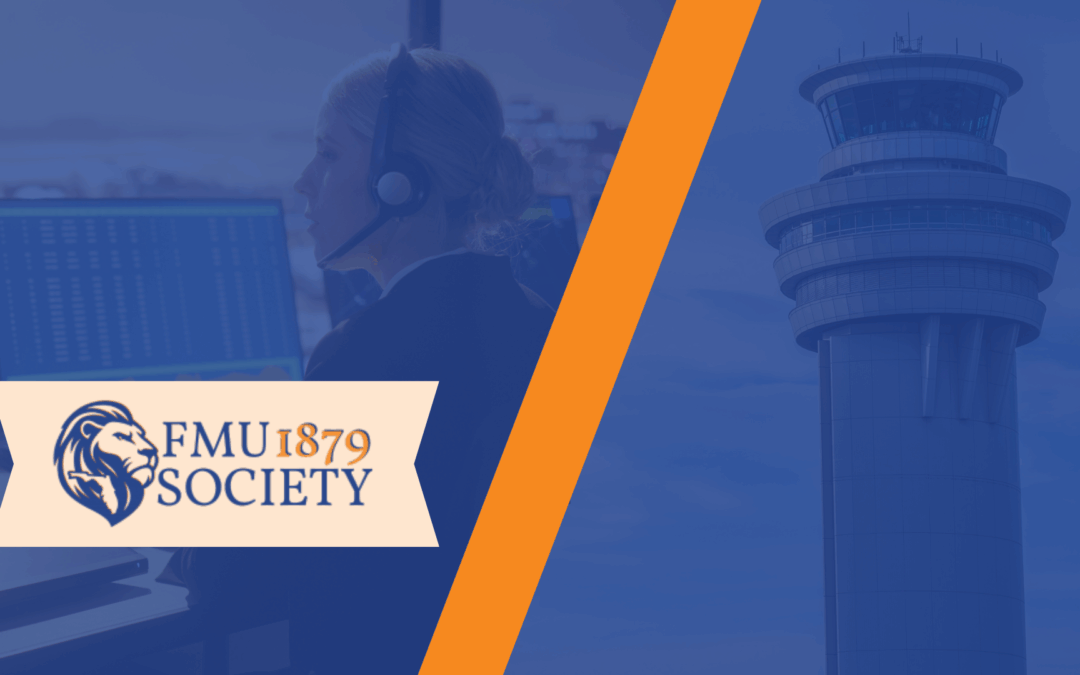
How Air Traffic Controllers Keep America’s Skies Safe—And How FMU’s 1879 Society Builds the Pipeline
Modern air travel is a true marvel of coordination. Behind every smooth takeoff and landing is a team of air traffic controllers (ATCs) monitoring radar screens, directing pilots and ensuring planes remain safely separated. Yet, the U.S. faces a persistent shortage of qualified controllers- which is currently exacerbated by a government shutdown. Our article explores why controllers are in such high demand, what it takes to become one and how Florida Memorial University (FMU) and our non-profit FMU 1879 Society are playing a vital role in safeguarding America’s airspace.
Why Air Traffic Controllers Are in High Demand
Air traffic controllers guide planes safely through crowded skies, from takeoff to landing. The Federal Aviation Administration’s (FAA) 2025 workforce plan warns of staffing shortfalls: it hired 1,811 controllers in FY 2024 but still faces thousands of vacancies as experienced controllers retire. The FAA aims to hire at least 8,900 new controllers through 2028, increasing starting salaries by nearly 30% to attract talent.
Despite a projected 1% job growth from 2024–2034 (slower than average), the U.S. Bureau of Labor Statistics notes that about 2,200 job openings per year will arise because many controllers reach mandatory retirement or transfer to other occupations. The job is demanding but lucrative: the median annual wage in May 2024 was $144,580, and experienced controllers earn over $210,000.
Impact of Controller Shortages
Staffing shortages strain the entire aviation system. In summer 2023, roughly 1 in 4 flights into New York were delayed partly because the region lacked trained controllers (check out the full report here). The FAA has implemented mandatory overtime and extended shifts, contributing to fatigue and burnout. According to the National Academies report, controller attrition rates range between 3 % and 11 % annually, with many trainees leaving during the three‑year developmental period. This revolving door makes recruiting and retaining qualified candidates critical for national airspace safety.
How to Become an Air Traffic Controller
The path to becoming an ATC is rigorous. Candidates must be U.S. citizens, pass a medical examination, undergo background checks and apply before age 30. The FAA’s hiring process includes the Air Traffic Skills Assessment (ATSA), a 3.5‑hour aptitude test that measures decision‑making, multitasking and spatial awareness (you can see what that’s all about at this link). Successful applicants then attend the FAA Academy in Oklahoma City for approximately three months, where they learn radar operations and communication procedures.
Exam & Training Challenges
Official pass rates for the ATSA are not public, but attrition during training is high (which is a good indirect measure of the difficulty). The FAA expects academy attrition(trainees who fail the academy) to increase from 603 losses in FY 2024 to 853 by 2028, owing to higher hiring targets. Developmental attrition (those who cannot certify at a field facility) averages 102 losses per year and is projected to double( as reported at faa.gov). These figures underscore the difficulty of the job and the importance of quality preparatory programs.
Collegiate Training Initiative (CTI) Programs
One way to prepare for the ATSA and FAA Academy is to enroll in an FAA‑approved Collegiate Training Initiative (CTI) program. Graduates of CTI programs still must pass the ATSA and meet all hiring requirements, but they receive foundational training that can shorten their time at the academy.
FMU’s Aviation & Safety Program: A Beacon for Aspiring Controllers
Florida Memorial University, an HBCU founded in 1879, offers an Aviation & Safety degree with an Air Traffic Control concentration. As part of the FAA CTI network, FMU’s program allows students to skip up to five weeks of training at the FAA Academy (you can check it all out at fmu.edu). Here’s what makes FMU stand out:
- Real‑World Facilities – Students train in an on‑campus control tower overlooking Opa‑Locka Executive Airport. The tower includes radar and voice communication simulators that replicate FAA procedures.
- Modern Aircraft & Discounts – FMU owns a Cessna 172S with a G‑1000 glass cockpit, giving students hands‑on experience with modern avionics. Students can fly at a discounted rate, making pilot training more accessible.
- Industry‑Connected Faculty – The program’s instructors bring decades of experience from airlines, airport management and the military. They teach both tower and en‑route procedures, preparing students for various FAA facilities.
- Mentorship & Internships – Through partnerships with airlines and airports, FMU provides internships and mentorship opportunities. Students gain exposure to commercial operations and build professional networks.
Success Stories
FMU students are already filling the controller pipeline. In early 2024, three juniors from the program (Dominic Barrett, Anivens Jean‑Louis and Draeden Ramsay) were tentatively accepted as air traffic controller trainees at the FAA Academy. They credited FMU’s faculty, rigorous curriculum and real‑world simulations for their success (read about it here). Such outcomes illustrate not only how FMU prepares students to meet the FAA’s stringent requirements, but also their commitment to each student’s success – a priority for any small college .
The FMU 1879 Society: Investing in Airspace Safety
The FMU 1879 Society is a non‑profit that supports the university’s mission and its Aviation & Safety program. Donations fund scholarships, simulator upgrades and outreach programs for under‑represented youth. By investing in FMU students, donors help address the national controller shortage and ensure that America’s skies remain safe.
How You Can Help
- Join the 1879 Society – Become a member and contribute to scholarships for future air traffic controllers. We have many donor levels to accommodate all who want to help their community.
- Sponsor a Simulator Session – Help fund advanced simulation hours so students can practice complex scenarios before facing them in the real world.
- Spread the Word – Help us bring awareness to our non-profit by sharing this blog, liking our social media pages, and telling your friends. We want to help as many students as we can, and assist Miami’s only HBCU, the best way we can.
Conclusion
Air traffic controllers are the unsung heroes of aviation. With retirements and high training attrition threatening the controller workforce, the United States needs institutions like Florida Memorial University more than ever. FMU’s comprehensive program and supportive 1879 Society cultivate the next generation of skilled professionals who will keep passengers safe and the national airspace efficient.
For aspiring controllers, donors and aviation enthusiasts, FMU offers a path to meaningful impact. By supporting the FMU 1879 Society, you help fill critical roles in the aviation industry and ensure that future generations can continue to fly safely.